


Cisco Certification – The Definitive Guide

CISCO Certifications: The Definitive Guide
Paying a visit to this page means that you are interested in attaining a certification offered by one of the most revered examination bodies in the IT community, CISCO. Therefore, view this guide as a comprehensive introduction to CISCO certifications, and the advantages they give you in the development of your IT career.
IT professionals who specialize in the field of networking and communications will find the road to obtaining a Cisco certificate, filled with multiple practical tasks and questions. These tasks, which are intended to gauge your understanding of networking, will also provide some of the greatest learning opportunities you will encounter in your journey to becoming an expert in this field.
An Introduction to Cisco
Cisco Systems Inc. is a tech company that specializes in providing networking and communications products as well as services. It is known worldwide for the quality of routers and switches it produces to manage direct data, video and voice traffic across the diverse networks business organizations rely upon. In addition to these products, Cisco also offers a diverse range of services to handle; storage networking, applications for IT communications and collaboration, cloud and data management.
Its array of products and services in the IT sector requires an in-depth understanding for individuals interested in successfully using or deploying them across various IT architectures. Therefore, to ensure that IT pros are equipped with the required abilities to handle the above products and services, the Cisco Career Certification program was created. The entire program was designed to accomplish two important tasks; educate IT pros on networking and communications, and highlight one’s ability to use Cisco’s native products and services.
The Benefits of Pursuing Cisco Certifications
As an established brand in the IT industry, obtaining a Cisco certification comes with multiple benefits for both individuals and businesses looking to compete in the global IT market.
The Benefits of Cisco Certifications to Individuals
- Global recognition—certified Cisco professionals earn the respect of both their peers and seniors in the IT community due to the effort you have put into passing the exams. This recognition increases your chances of a promotion when working in corporate organizations.
- A Competitive edge—acquiring a Cisco certificate gives you the added advantage of having certified your skills with using its products and services. Therefore as a certified professional applying for a job, employers will be partial to your qualifications before considering other applicants.
- Access to Cisco’s resource centres—Cisco provides certified BISCI members with access to its considerable learning materials as well as technical support when the need arises. Therefore, certified pros can receive advice directly from Cisco’s technicians when troubleshooting its products or services.

The Benefits of Cisco Certifications to Businesses
- Develop effective business models—Cisco certifications provide IT pros with an extensive understanding of the IT market and how to leverage it. This allows corporate organizations to develop new ideas and models that ensure profitability is maintained.
- Increased Productivity—statistics fromForbesshow that businesses that hire certified professionals, innovate and function faster than their counterparts. Businesses with Cisco certified pros integrate the use of state-of-the-art IT products and services that exponentially increase employee productivity levels.
- Provide exceptional customer experiences—Cisco products are geared towards simplifying operational procedures and customer experiences through the use of secure networks and seamless communication channels. And certified IT pros can engage with Cisco’s products to enhance customer satisfaction.
- Earn clients trust—Organizations with Cisco certified professionals are more likely to bring in more business, have satisfied customers and recurring transactions from loyal clients due to the status of their employees. Cisco’s respected position in the global IT community is transferable to employees who have acquired its certifications.
But before these credible benefits can be reaped, one must first participate and successfully pass at least one of the certification examinations and go through the processes that will be outlined in the next section.
Cisco Certification Program Overview
To understand the certifications Cisco offers, it is necessary that you have a full understanding of the different categories—which are defined by Cisco’s products and services—and the certification levels under them.
Cisco Certification Categories
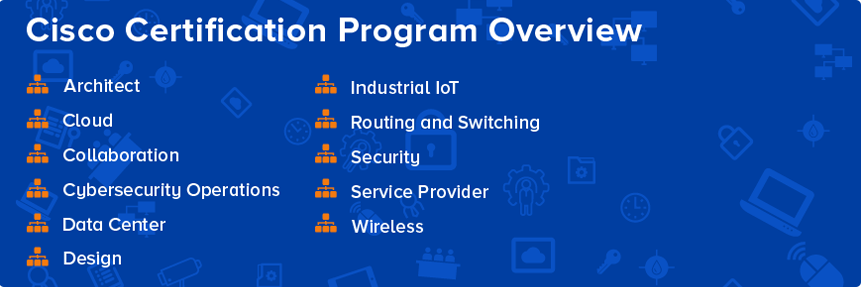
Cisco boasts a wide array of products and services which cut across the networking and communication industry. Therefore, its examination body makes use of categories to ensure interested candidates know the exact certifications which fit their career goals. The categories include:
- Architect—this certificate is for professionals with the ability to translate complex business problems, recommend and deploy Cisco and other networking-related solutions to solve these issues. It is the one of the most advanced certification one can pursue under the Cisco certifications umbrella.
- Cloud—Cisco offers multiple certifications surrounding the deployment and integration of cloud solutions across diverse IT infrastructures. The certifications focus on your ability to use Cisco’s cloud products and services.
- Collaboration—this certification focuses on IT pros who intend to specialize in networking and collaboration services. The certification covers the realm of IP telephones, IP networks, voice, data and mobile applications.
- Cybersecurity Operations—this is for engineers who troubleshoot cybersecurity breaches and other security related issues. Cisco cybersecurity certifications provide an excellent opportunity to do so.
- Data Center—deploying and maintaining data infrastructures now play a key role in today’s business operations. Therefore, IT pros in the data niche can certify their abilities with Cisco Application Centric Infrastructure as well as other data management tools by obtaining a Cisco certification.
- Design—network designers and support engineers who design data centers, security and wireless networks can pursue a Cisco certification in design. This authenticates your ability to troubleshoot and create IT networks.
- Industrial IoT—the internet of things industry is currently one of the trending niches in the tech community and Cisco tests your ability to deploy networks and other products across interconnected smart systems.
- Routing and Switching—IT professionals interested in controller-based architecture and the routing and switching products Cisco offers can pursue a certificate that highlights your abilities with them.
- Security—the security category offers IT pros interested in network security, security administration and security support etc. with certification opportunities. Here, your ability to use Cisco’s securities and products will be determined.
- Service Provider—this category provides certifications to professionals in the managed IT services industry and the service provider network industry. It provides these professionals with a great opportunity to test and certify their abilities.
- Wireless—certifications in the wireless category test the ability of engineers and IT support personnel to use Cisco’s wireless equipment to support wireless LAN. It also covers the management of wireless LAN configurations and networks.
The certifications provided in these categories are further broken down into different levels that depend on theprofessional level of prospective candidates. These levels which range from entry-level to expert-level certifications will be outlined below.
Cisco Certification Levels
Currently, there are five certification levels offered by Cisco and these are; entry, associate, professional, expert and architect. As expected, certifications from each category listed above divide the certificates they offer across the four levels. And here are the levels as well as the certifications under them:
- Entry—Cisco entry level certifications are introductory exams designed to test that one understands basic networking and communicating terms and technologies. It provides an entry point for IT personnel interested in attaining professional certificates. Entry level certificates include; CCENT and CCT.
- Associate—associate Cisco certifications serve as a solid foundation for networking professionals looking to obtain networking certificates. The certification process teaches you to be conversant with Cisco’s product and services while building your knowledge base up for more advanced pursuits. Associate level certifications include: CCDA and CCNA. Interested candidates can earn a CCDA or CCNA certificate in most of the categories outlined in the ‘Cisco certification categories’ section.
- Professional—Cisco’s professional level certifications consist of a more advanced testing process. It was developed to test your networking skills, and ability to use the products and services offered by Cisco. Professional level certificates cut across the different ‘Cisco certification categories’ and they include: CCDP and CCNP certificates.
- Expert—this certification is one of the most advanced certifications Cisco has to offer. These certificates cut across the different ‘Cisco certification categories’ and they include: CCDE and CCIE.
- Architect—attaining a Cisco architect certification is the highest level an IT pro can go in the world of networking, communications and design. The certification process examines your ability to develop or troubleshoot advanced network problems and create technical strategies for large corporations. The certificate on offer is the CCAr.
Cisco Certification Categories and the Available Certification Levels
In this section, we’ll cover the various certifications, and the corresponding levels that can be attained in each category. This guide will also touch on the criteria, exam and study areas you must cover in order to successfully obtain a certificate

Cloud Certifications
CCNA Cloud Certification
Cisco’s CCNA cloud is a certification and training program designed to assist cloud engineers, administrators and IT pros in validating their skills in solving cloud-based networking issues using Cisco’s services and devices. It is an associate level certification which means it was created for job-oriented candidates looking to validate their cloud networking abilities.
Required Exams—the topics candidates must cover include; cloud administration and fundamentals using Cisco’s products and services, provisioning clouds and cloud management. Candidates will complete the following exams:
CCNP Cloud Certification
To be eligible for the CCNP certification, you must have obtained CCNA cloud to enable you to sit the CCNP examinations. The certification process relies on lab work to test your ability to design, provision, automate and manage cloud infrastructures. Candidates must consider tutorial or training in; designing Cisco cloud, implementing and troubleshooting Cisco cloud infrastructure, automating Cisco enterprise cloud and building Cisco cloud. The exams to take are:
The certificate is valid for 3 years and to recertify candidates must pass any current CCIE exam or CCDE exam or the CCAr interview and board review.

Collaboration Certifications
CCNA Collaboration Certification
This certification is a great way for network engineers, IT technicians and IT pros to validate their knowledge of voice, video, data and mobile applications in relation to Cisco’s collaborative products. Candidates will have to cover topics on implementing; Cisco collaboration devices, Cisco’s video network devices and administration of end-user interfaces, mobility apps etc. Its exams include:
CCNP Collaboration Certification
This is a professional certification covering the use of Cisco’s collaboration and mobility applications. It is important to note that a CCNA collaboration certificate or a valid CCIE certificate is a pre-requisite for sitting the exams. The topics to be covered include implementing; Cisco IP and telephony and video, Cisco collaboration applications and troubleshooting video communications servers, TelePresence management suites etc. its exams include:
The certificate is valid for 3 years and to recertify candidates must pass any current CCIE exam or CCDE exam or the CCAr interview and board review.
CCIE Collaboration Certificate
This is an expert certification for collaboration architects, unified communication architects and IT networking pros looking to validate their skills with designing, implementing and solving complex collaboration problems. There are no prerequisites for obtaining a CCIE certificate. The certification program consists of two steps; a written exam and lab work. The certification program includes:
- CCIE written exam
- CCIE Lab exam.

Cybersecurity Operations Certificates
CCNA CyberOps Certification
The CyberOps certification covers the fundamentals of monitoring cyber systems and tackling security breaches. Obtaining this certification opens doors for IT pros partial to cybersecurity. Topics to study for this exam include: Cisco cybersecurity fundamentals, Cisco cybersecurity operations, cybersecurity principles and concepts. Candidates will have to pass;

Data Center Certificates
CCNA Data Center
The data center certification is a great way for data architects and scientist to validate their understanding of data infrastructure, storage networking, unified computing, automation and data virtualization. The subjects candidates must cover include; Cisco data center networking, Cisco UCS architecture and Cisco data technologies. The certification exams include:
CCNP Data Center
Candidates interested in obtaining this certificate must have first gotten the CCNA Data Center certificate. The CCNP Data Center is a professional certificate that test applicants on their ability to design, manage, and troubleshoot data infrastructures. The topics you should cover include implementing; Cisco data center unified computing, Cisco data center unified fabric, Cisco unified computing systems, Cisco switches etc. The exam includes:
- 642-999 DCUCI or 300-175 DCUCI
- 642-997 DCUFI or 300-165 DCII
- 300-170 DCVAI
- 642-998 DCUCD
- 642-996 DCUFD
- 642-035 DCUCT
- 642-980 DCUFT or 300-180 DCIT
The certificate is valid for 3 years and to recertify candidates must pass any current CCIE exam or CCDE exam or the CCAr interview and board review.
CCIE Data Center
The Cisco Certified InternetWork Expert data center certificate is a job-centric advanced certificate. IT pros and data scientists or architects pursue the CCIE data center as a means of validating their abilities to lead when providing solutions that involve data centers and emerging technologies. Pursuing a CCIE data center certificate comes without any prerequisites, but having 8 years of job experience in data management is recommended. The exam consists of a written section and lab work.

Design Certificates
CCENT Design Certification
This is an entry-level certificate that tests your ability to install, operate and troubleshoot a small enterprise branch network. It validates your understanding of networking and communication. Interested candidates should focus on interconnecting Cisco networking and Cisco devices for the exam which is:
CCDA Design Certification
This is an associate certificate aimed at Systems engineers, network design engineers and IT pros. The certification focuses on routing protocols, the design methodologies, network expansion etc. To be able to go through this certification there are certain prerequisites you must obtain. The prerequisites include; CCENT or a CCIE certificate or a CCNA routing and switching certificate. The required exam candidates must pass is:
CCDP Design Certification
The CCDP certification is a professional certificate for System engineers, networking engineers and IT pros looking to validate their implementation abilities. It is a great way to build on the fundamentals of design and your understanding of Cisco networking services. Interested candidates must study; Cisco IP routing, Cisco IP switched networks and designing Cisco networks architecture. Its exams include:
CCDE Design Certification
This is a more advanced certification that tests candidate’s ability to design, provision and deploy networks for a big corporation with large customer bases. Pursuing for the CCDE certificate comes with no prerequisites but to successfully pass the certification program, candidates must prepare for both a written exam as well as practical one. These are designed to test your understanding of Cisco network products/services and your ability to apply them.The certificate is valid for only two years and you will have to pass either the current CCIE or CCDE written or practical exam.
CCAr Architect Design Certification
This is also an expert certification designed for senior networking professionals who develop technical networking strategies for businesses. Prospective candidates must have obtained a Valid CCDE certification and a provable knowledge of the principles of networking infrastructure. It is important to note that this certificate is valid for 5 years and to recertify, you must have to be an active contributor to the Cisco Certified Architect Program. Activities you can contribute to include:
- Creating new exam content
- Reviewing existing content
- Developing future directions for Cisco programs

Industrial/IoT Certificates
CCNA Industrial Certification
The move towards an interconnected world currently drives the tech community, and a CCNA industrial certification validates your skills as an IoT professional. The certification was developed for Systems engineers and network engineers who have a good knowledge of industrial networking, Cisco networking and design. The exams to take include;

Routing and Switching Certificates
CCENT Routing and Switching Certificates
This is the entry certification needed to pursue more advanced certifications in Cisco’s routing and switching ecosystem. Obtaining a CCENT validates your ability to manage a small enterprise branch network, as well as your understanding of Cisco’s router and switching products. To prepare for the certification exam, candidates should focus on router, switches and networking. The exam to sit for is:
- 100-105 ICNDI
CCNA Routing and Switching Certificates
The CCNA routing and switching certificate is an associate certification that covers network transmission, and implementing Cisco routers and switches in an ecosystem. The exam equips you with the knowledge required to pursue more advanced certifications from Cisco. Interested candidates must cover the following topics: Cisco networking devices, IPV6, QoS elements, virtualized and cloud services. The exams to be taken are:
CCNP Routing and Switching Certificates
The CCNP is a professional certification that validates a systems engineer or network engineer’s ability to plan, implement, verify and troubleshoot local and wide-area enterprise networks. Prospective candidates must already have a CCNA routing and switching certificate in the bag or any Cisco CCIE certificate. The topics to be covered include; implementing Cisco IP routing, switched networks and troubleshooting/maintaining IP networks. The exams for this program are:
The certification stays valid for 3 years and to recertify candidates must pass any current CCIE exam or CCDE exam or the CCAr interview and board review.
CCIE Routing and Switching Certificates
This is an advanced certification for experts interested in validating their abilities to plan, operate and troubleshoot complex network infrastructure. There are no official prerequisites for this certificate but candidates are advised to have had 5 years job experience in routing and switching and a good knowledge of networking. The exam consists of a written test and hands-on lab work to determine your application abilities. The certificate is valid for 2 years and to recertify you must:
- Pass a current CCIE written exam or lab work
- Pass a current CCDE exam or
- Pass the CCAr interview stage.

Cisco Security Certificate
CCENT Security Certification
CCENT Security certification is an entry-level program that focuses on networking, communication, security, and Cisco’s cybersecurity services. Successfully passing this program opens a window of opportunity for IT pros looking to advance in the field of network security. The exam to be taken is:
CCNA Security Certification
This associate program was created for working professionals interested in validating their abilities to develop security infrastructure, recognize threats and mitigate risk from IT infrastructures. Interested candidates will have to cover the topics on implementing Cisco network security applications and data infrastructure used by business organizations. The exam to pass is:
CCNP Security Certification
The CCNP certification highlights an engineer’s ability to secure routers, switches and networking devices from external security threats. For those interested in participating in this program, having a valid CCNA security certificate or any CCIE certificate is a prerequisite for more advanced security studies. Topics include; implementing Cisco secure Access Solutions, implementing Edge network solutions, implementing Cisco’s mobility solutions and threat control solutions. The exams in this program consist of:
The certificate is valid for 3 years and to recertify you must pass any current CCIE exam or CCDE exam or the CCAr interview and board review.
CCIE Security Certification
This is a certification program designed to recognise security experts with advanced knowledge in implementing Cisco’s security products and services across diverse networks and devices. Candidates who are interested in attaining this certification must pass a written exam and showcase their abilities to deploy security equipment. The exams include:
The certificate is valid for only 2 years and to recertify, candidates must meet the following requirements:
- Pass a current CCIE exam or Lab exam
- Pass the current CCDE exam or practical exam
- Be active in the Cisco community

Cisco Service Provider Certificates
CCNA Service Provider Certification
This is an associate certification that validates an IT professional’s ability to work with Cisco service provider applications. It focuses on your ability to configure, provision, and implement Cisco’s baseline technologies for business enterprises. Prospective participants will have to study building Cisco service provider networks, introduce IP networks etc. The exams you will take are:
CCNP Service Provider Certification
Any IT pro responsible for delivering scalable-infrastructure equipped with the ability to manage added load on its infrastructure can validate their abilities through the CCNP SP program. This is a professional certification for senior engineers interested in adding to their knowledge of deploying Cisco service provider networks and advanced routing solutions. The exams to take include:
It is important to note that the certificate is valid for 3 years and to recertify you must pass the current CCIE exam or CCAr interview.
CCIE Service Provider Certification
The CCIE SP is the most advanced certificate for senior engineers looking to highlight their abilities with Cisco’s service provider applications. Although there are no prerequisites, it is advisable to have some job experience implementing service provider suites. The written and lab exams test your ability to build a service provider infrastructure capable of delivering excellent managed IT services.
The certificate is valid for two years and to renew it, you must pass the current CCIE exam or lab work or pass the CCAr interview.

Cisco Wireless Certificates
CCENT Wireless Certification
This is an entry level certificate that tests your understanding of wireless technologies, Wireless LAN, Cisco wireless products and networking. Individuals looking to explore the world of wireless networks can start with this certification. The certificate exam to take is:
CCNA Wireless Certification
The CCNA wireless is an associate exam which focuses on your knowledge of configuring wireless LAN, monitoring, and troubleshooting connectivity issues. Obtaining this certificate is an excellent way to validate your skills with wireless networks. Candidates must study the following topics covering; fundamentals of wireless, defining Cisco’s wireless LAN essentials and wireless networks. The exam for this certification is:
CCNP Wireless Certification
This is a professional certificate that tests your knowledge of designing, implementing and securing Cisco Wireless networks to maximise its performance. Interested candidates must have first obtained the CCNA wireless certification and cover topics on; designing Cisco wireless enterprise networks, deploying enterprise networks and troubleshooting/securing Cisco enterprise networks. The exams for this certification are:
The certificate is valid for 3 years and to recertify candidates must pass any current CCIE exam or CCDE exam or the CCAr interview and board review.
CCIE Wireless Certification
The Cisco certified internetwork expert wireless certificate was designed to assess and validate your expertise with wireless technology. There are no official prerequisites for pursuing this certification, and interested candidates are advised to focus on these study areas; wireless technology, evolving technologies and Cisco WLAN. The exam which is both written and lab based consists of:
- 400-351 CCIE Wireless
- CCIE Wireless Lab Exam
The certificate is valid for 2 years and to recertify you must pass the CCIE written exam or oral exam.
Learning and Training Materials
Cisco is an established IT firm which offers its certification exams through Pearson VUE and other registered bodies. It also partners with accredited tutorial organizations who provide Cisco certification materials and teachers who understand its products and services. Therefore interested candidates can find tutorials as well as tutors on:
- SkillsBuild Training
- Cisco’s official certification web page
The Salary Benefits of a Cisco Certificate
The benefits of obtaining a Cisco certification for both individuals and business organizations has been outlined in previous paragraphs but in this section, its benefit in terms of salary will be discussed. The salaries below highlight what certified professionals across the 5 certification levels earn per annum.
Average CCNA certified professional—earns $54,000 to $89,000 USD
Average CCNP certified professional—earns $90,000 to $94,000 USD
Average CCDA certified professional–$60,000 to $89,000 USD
Average CCDP certified professional—earns $90,000 to $100,000 USD
Average CCDE certified professional—earns $100,000 to $150,000 USD
Average CCIE certified professional—earns $96,000 to $175,000 USD
Cisco is renowned worldwide for its products and services. Individuals new to IT, and IT professionals looking to move further in their career should seek to obtain a Cisco certificate as one of the most important tools to achieving their career goals.